Pro-Am vs Amateur Ballroom Competitions: Which Is Right for You?
Pro-am or amateur? How each path in competitive ballroom dancing works, what it costs, how you are judged, and how to choose the right one for your goals.

The two main paths in competitive ballroom dancing, explained side by side so you can choose with confidence.
If you have started thinking about competing, you have probably heard two terms over and over: pro-am and amateur. They describe who you dance with, how you train, how much it costs and, to a large extent, what your competitive life will look like.
Neither path is better. They suit different people, different schedules and different goals. Many dancers do one, then the other, and some do both at the same time. This guide explains how each works and gives you a clear way to decide.
The quick definitions
- Pro-am (professional-amateur): you, an amateur student, compete with your professional teacher as your partner.
- Amateur: you compete with another amateur dancer. The two of you are a partnership, and you train together with one or more coaches.
There is also a third option, the showcase, which we cover below. It lets you perform a routine without competing in a regular heat.
How pro-am works
Your teacher is your partner
In pro-am, you dance with your professional teacher. If you are a woman, a male professional leads you. If you are a man, you lead a female professional. Either way, you do not need to find a partner, coordinate two schedules or depend on anyone else's commitment. That is why most adults who start competing begin in pro-am.
Only you are judged
This is the part that surprises many people. In pro-am events, the judges mark the amateur student, not the professional. Your teacher's job is to partner you well and make you look your best. Your technique, timing, posture and presentation are what count.
Levels and age groups
Pro-am events are divided by level and by age group, so you compete against students at a similar stage of learning and a similar age. Common levels in the U.S. are Newcomer, Bronze, Silver, Gold and Open, and each level limits which figures you can dance. Learn more in What Is DanceSport?
Event formats
- Single-dance heats: you dance one dance, such as a waltz or cha cha, and are marked on that dance alone. Many students enter several of these.
- Multi-dance events: you dance a set of dances in a row and are marked overall. These are often called championships or scholarships.
- Solos and showcases: you perform a choreographed routine alone on the floor.
In the U.S., many pro-am events run under the rules of the National Dance Council of America (NDCA). Your coach will know which events suit your level.
How amateur works
You and a partner
In amateur competition, two amateurs dance together. You might be a married couple, friends, or a partnership put together through a studio or a coach. You practice together, take lessons together and compete as a team.
Both partners are judged
The judges mark the couple as a unit: how well you move together, your connection, your technique and your presentation. A great amateur partnership looks like one body on the floor.
Where amateurs compete
Amateur couples compete at many of the same events as pro-am dancers, in separate amateur categories. In the U.S., USA Dance also runs a large number of amateur competitions. Amateur events are divided by level and age as well.
Side-by-side comparison
- Partner: pro-am uses your teacher; amateur needs another amateur dancer.
- Scheduling: pro-am depends on your schedule and your teacher's; amateur depends on two dancers' schedules plus coaching.
- Who is judged: pro-am judges the student only; amateur judges the couple.
- Learning speed: pro-am students often progress fast because they always dance with an expert; amateur couples learn more slowly at first but develop strong partnership skills.
- Cost structure: pro-am costs are higher per event because the professional's time is included; amateur costs are usually lower per event but the partnership pays for its own coaching and practice time.
- Commitment: pro-am is a commitment between you and your teacher; amateur is a commitment between two people, which brings both support and dependence.
What each path costs
Prices vary widely between studios, teachers and events, so always ask for an estimate before you commit. What matters here is understanding where the costs come from.
Pro-am costs usually include
- private lessons to prepare your routines
- entry fees for each heat or event you enter
- a fee for your professional's time at the competition, which often depends on how many heats you dance
- a share of your professional's travel costs for out-of-town events
- your own costume, shoes, travel, hotel, hair and makeup
Amateur costs usually include
- coaching lessons, which the couple usually shares
- practice time at a studio
- entry fees for the couple
- two sets of costumes, shoes and travel
The simplest way to keep pro-am costs reasonable is to enter fewer, better-prepared heats. Ask your teacher to help you plan a budget for the season, not just for one event.
Pros and cons
Pro-am
- Pros: no need for a partner; dancing with an expert from day one; fast progress; flexible scheduling; you can compete as often or as rarely as you like.
- Cons: higher cost per event; you depend on one teacher's schedule; you do not develop the same partnership skills as an amateur couple.
Amateur
- Pros: lower cost per event; a partner to practice with at any time; deep partnership skills; the shared experience of building something together.
- Cons: finding a well-matched partner can take time; two schedules, two sets of goals and two levels of commitment have to line up; progress depends on both people.
Which path is right for you?
Pro-am is usually the better start if:
- you do not have a dance partner, or your partner does not want to compete
- you have a busy or unpredictable schedule
- you want to progress quickly with expert partnering
- you want to try competing before making a big commitment
Amateur is usually the better choice if:
- you already have a partner with similar goals, level and availability
- you want to compete often and keep costs per event lower
- you enjoy the challenge of building a partnership
- you are prepared to practice together regularly, outside lessons
Can you do both?
Yes. Many dancers compete pro-am with their teacher and amateur with a partner at the same event, in different categories. Others start in pro-am, build their technique and confidence, then move into an amateur partnership. Skills from either path help the other.
The third option: showcases
A showcase is a performance, not a ranked heat. You dance a choreographed routine for an audience, usually with your teacher. Showcases are a wonderful way to perform without the pressure of being placed against other couples, and many students use them as a stepping stone before their first competition.
Questions to ask your coach before you decide
- Which events do you recommend for my level, and why?
- How many heats should I enter at my first event?
- What will the total cost be, including your fees and travel?
- How many lessons per week do you recommend before the event?
- Do you coach amateur couples as well as pro-am students?
- What would you want me to focus on for the next six months?
A good coach answers these openly and helps you build a plan you can sustain.
Frequently asked questions
Am I too old to start competing?
No. Pro-am and amateur events are divided by age group, so you compete against dancers of a similar age. Many adults start competing in their forties, fifties and beyond.
Do judges score the professional in pro-am?
No. In pro-am events, only the amateur student is judged.
Can men compete in pro-am?
Yes. Male students dance with a female professional and lead her, just as they would lead an amateur partner.
How long do I need to train before my first competition?
It depends on your starting point, but many social dancers with solid basics can prepare one or two dances for a first Newcomer or Bronze heat in a few months of regular lessons. See How to Prepare for Your First Dance Competition for a full plan.
How do I find an amateur partner?
Ask your coach and your studio first. Teachers often know dancers at a similar level who are looking for a partner. Look for someone with similar goals, availability and commitment, not just a similar height.
Coaching for both paths in Dallas
Jelena Stojkovic is a World Cup Champion, 14-time National Champion and International Winner, and has been named a Top Female Teacher in the United States nine years in a row. She coaches pro-am students and amateur couples in the Dallas area, from first-time Newcomers to experienced competitors. Learn more about our competitive ballroom and DanceSport coaching, or book a private coaching session to talk through which path fits you. Before your first event, have a look at our competition packing list and competition makeup guide.
AscenDance coach's tip: Choose the path that fits your life right now, not the one you think you should choose. A path you can sustain for a year will take you much further than a perfect plan you drop after one competition.
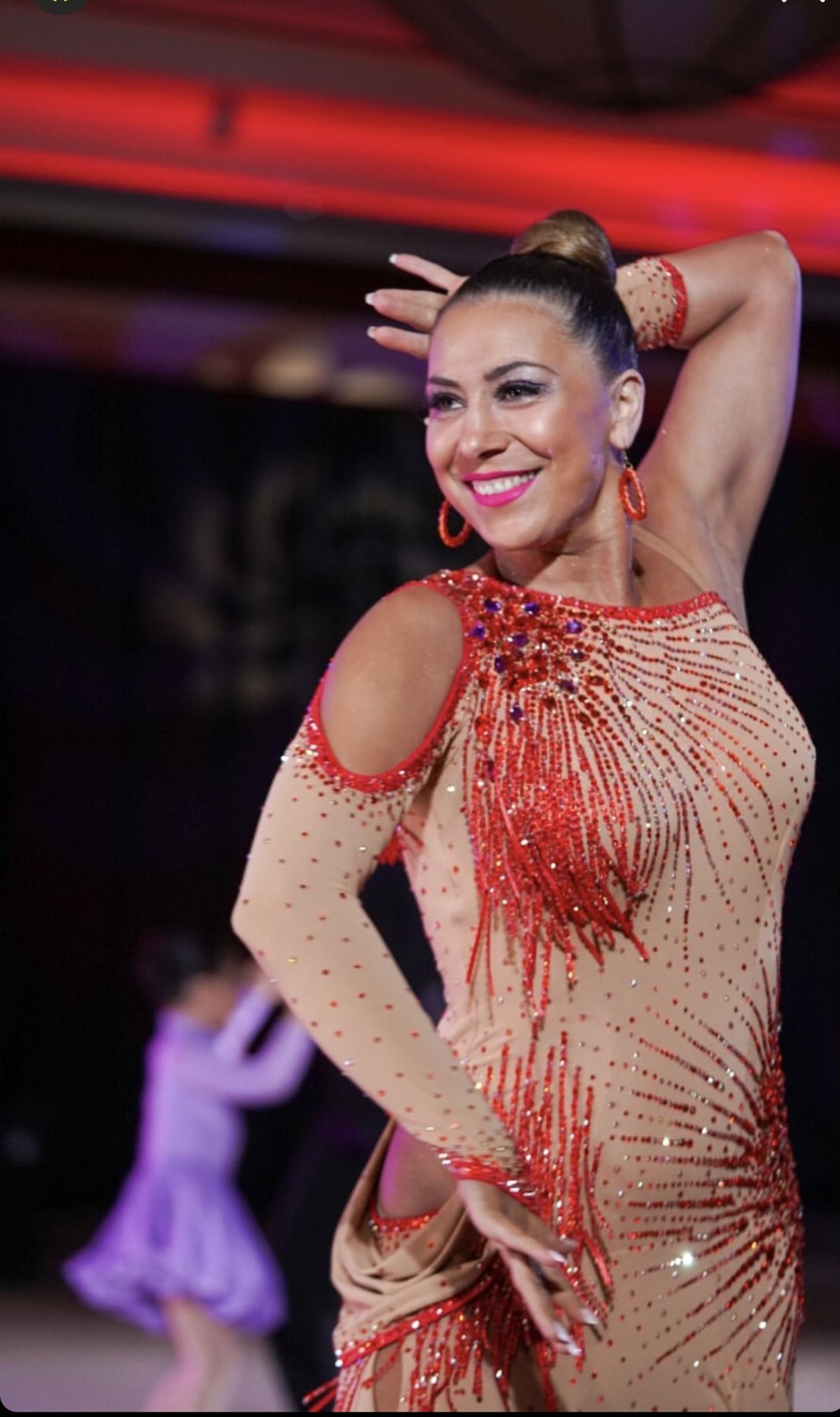
Jelena Stojkovic
Founder of AscenDance Studio. World Cup Champion, 14-time National Champion, International Winner, and Top Female Teacher in the USA nine years in a row, with more than 30 years in dance.
About Jelena →Book your first lesson
Private lessons in Addison, beginner Latin group classes in Dallas, and wedding first dance preparation.
14833 Inwood Rd
Addison, TX 75001
By appointment only
18484 Preston Rd #201
Dallas, TX 75252