
Why Ballroom Dance Is One of the Best Exercises for Your Brain
Ballroom dance trains memory, focus, balance, rhythm and decision-making at the same time. What neuroscience says about dance and the brain.
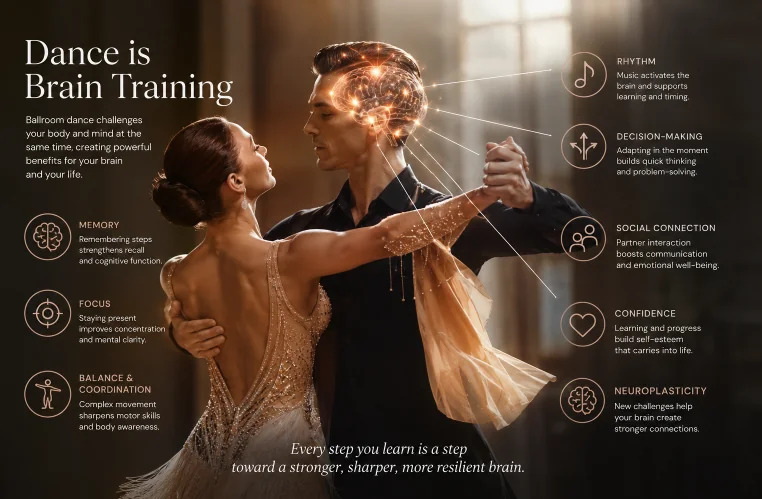
What neuroscience is revealing about movement, memory and mental performance.
Most people think of dance as physical exercise, and they are right. It strengthens the body, improves balance and builds endurance. But some of the most remarkable changes happen somewhere you cannot see: inside your brain.
Your brain loves a challenge
Every ballroom lesson asks your brain to solve dozens of problems at once. You are listening to the music, recalling movement patterns, adjusting your posture, coordinating your feet, anticipating your partner's next move and making split-second decisions, all while continuing to move.
Few activities challenge so many brain and body systems at the same time. That is one reason researchers have become increasingly interested in partner dance as a demanding form of combined cognitive and physical training. One widely cited study of older adults, published in the New England Journal of Medicine in 2003, found that frequent dancing was associated with a lower risk of dementia, a stronger association than for many other leisure activities studied.
Dance activates multiple brain systems at once
Most forms of exercise focus mainly on one or two systems. Running develops cardiovascular endurance. Strength training builds muscle. Ballroom dance works differently.
It engages memory, coordination, rhythm, balance, spatial awareness, decision-making, emotional expression and social interaction at the same time. These systems do not work independently; they communicate constantly throughout every lesson.
The brain's ability to form and strengthen neural connections throughout life is called neuroplasticity. Dance is a good environment for it because every lesson introduces new patterns, challenges and experiences that require the brain to keep learning.
Why forgetting your steps is actually good for you
One of the biggest frustrations for beginners is forgetting the choreography. Ironically, that struggle is exactly what helps the brain improve.
Every new combination forces your brain to build a new movement pattern. At first it feels unfamiliar, even uncomfortable. With repetition, those pathways become stronger, faster and eventually automatic. This process, called motor learning, is one of the brain's most effective ways of adapting throughout life.
Learning choreography is not only about memorizing steps. It teaches your brain how to learn. If the process feels slow, read Why Can't I Learn to Dance Faster?
It strengthens far more than memory
A ballroom lesson is a continuous exercise in attention. Within a few seconds you are listening to the music, feeling the rhythm, maintaining posture, staying connected with your partner, adjusting your balance, thinking ahead and staying fully present.
Many dancers notice improvements in:
- focus and concentration
- decision-making
- coordination and balance
- body awareness
- confidence
- mental agility
For many students, these changes show up in everyday life before they notice technical improvements in their dancing.
Music does far more than set the mood
Music is not just background sound. It is structure. The brain naturally predicts rhythm, which makes it easier to coordinate movement and remember sequences. That is one reason many people can recall an entire dance routine more easily than a spoken list of instructions. Rhythm gives the brain a framework it is wired to follow.
Why partner dancing changes everything
Ballroom dance adds something most exercise never does: another person.
Every lead, every follow and every adjustment depends on communication without a single word. Your brain constantly reads small changes in pressure, direction, timing and body position, and responds almost instantly. That mix of movement, decision-making and human connection creates a level of mental engagement that is hard to recreate in a traditional workout.
The goal of ballroom dance is not simply to teach your feet where to go. It is to teach your brain how to adapt.
Which dances challenge the brain most?
- Slower dances such as Waltz, Foxtrot and Rumba train balance, posture and precise control.
- Faster dances such as Cha Cha, Salsa and Swing train quick decisions and timing.
- Learning several styles is the biggest challenge of all, because the brain has to switch between different rhythms and techniques.
Your brain never stops learning
One of the best things about ballroom dance is that there is always another challenge waiting: a new rhythm, a new technique, a new partnership, a new goal. Unlike repetitive workouts that eventually become automatic, ballroom dance keeps asking your brain to adapt, solve problems and improve. That lifelong learning may be one of the greatest gifts dance offers, and it is one reason adults of every age thrive in the studio; see Why Adults Learn Ballroom Dancing Differently.
Final thoughts
People usually start ballroom dancing for simple reasons: to prepare for a wedding, to try something new, to stay active, to meet people, or just to have fun. What many do not realize is that every lesson is also an investment in their brain.
Every new step strengthens more than movement. It strengthens attention, memory, coordination and confidence. And perhaps most importantly, it reminds us that learning does not stop with age. It simply finds new ways to move.
Start with our beginner Latin group classes in Dallas or a private lesson in Addison.
This article is for general information and is not medical advice.
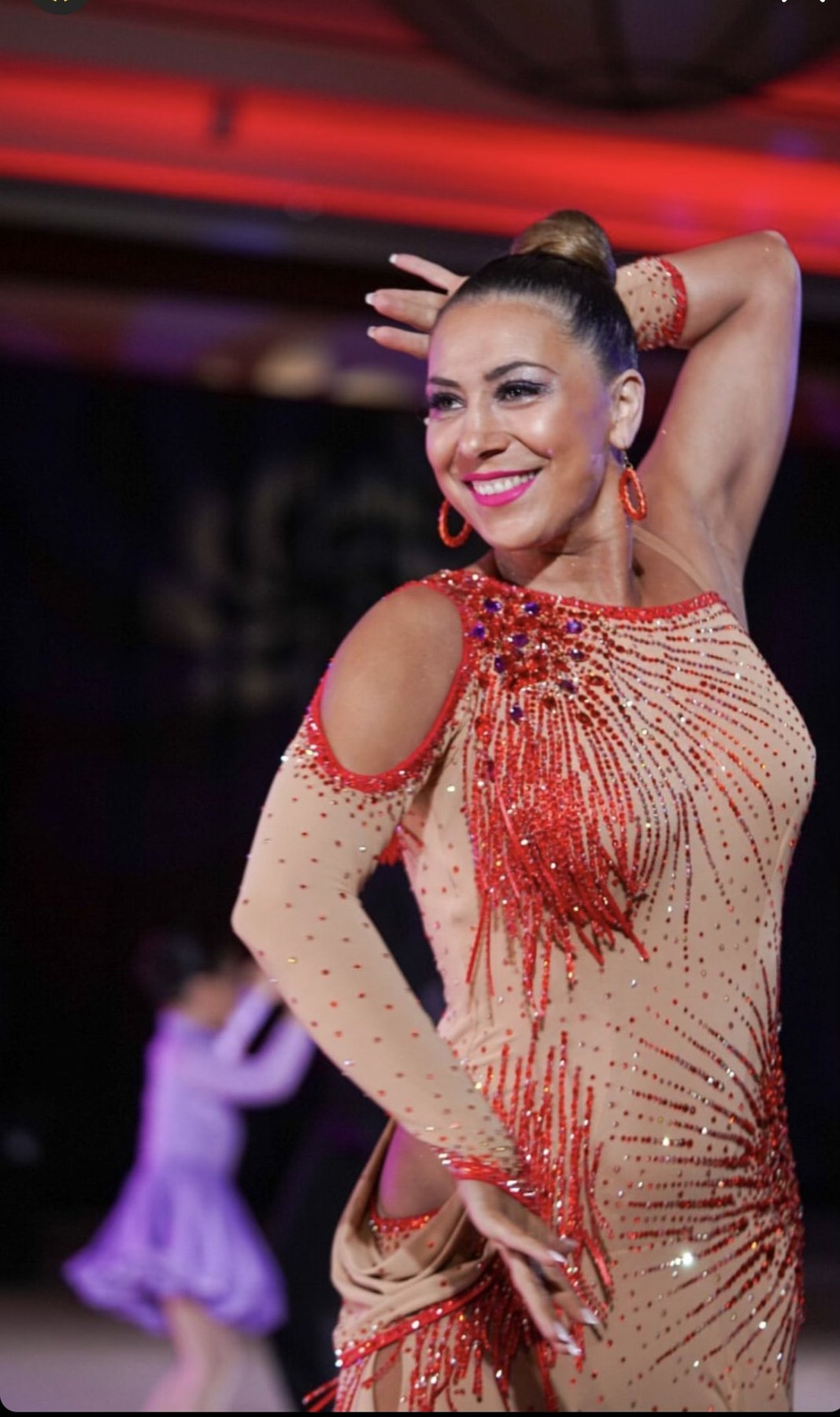
Jelena Stojkovic
Founder of AscenDance Studio. World Cup Champion, 14-time National Champion, International Winner, and Top Female Teacher in the USA nine years in a row, with more than 30 years in dance.
About Jelena →Book your first lesson
Private lessons in Addison, beginner Latin group classes in Dallas, and wedding first dance preparation.
14833 Inwood Rd
Addison, TX 75001
By appointment only
18484 Preston Rd #201
Dallas, TX 75252